
Legal Preparedness: The Missing Piece of Workplace Wellness
Executive Summary
Over the past several decades, workplace wellness has expanded beyond physical health to encompass mental health, financial well-being, caregiver support, and other dimensions of employees' lives that affect their ability to function and thrive at work. The expansion has not occurred all at once, nor has every initiative produced identical results. It has nevertheless reflected a recurring organizational insight: when employees are asked to navigate complex, consequential systems, timely education and access to appropriate resources can improve preparedness and reduce avoidable confusion.
One important dimension of employee well-being has received comparatively little attention: legal preparedness. Major life events such as caring for an aging parent, losing a loved one, going through a divorce, purchasing a home, planning an estate, responding to identity theft, or helping a child transition into legal adulthood frequently carry legal implications. Employees often confront those implications while simultaneously managing emotional stress, financial uncertainty, and the demands of work.
This Executive Brief examines whether practical legal education may deserve consideration as an emerging component of a comprehensive workplace wellness strategy. It does not suggest that employers should provide legal advice or replace attorneys. Rather, it asks whether helping people understand the legal dimensions of predictable life events before those events become urgent could complement existing wellness initiatives, improve confidence, and help employees use professional resources more effectively.
The argument is deliberately modest. Preventive Legal Wellness is not yet an established field with a mature body of outcomes research. The evidence reviewed here comes largely from adjacent disciplines, including caregiving research, financial wellness, health literacy, emergency preparedness, and cybersecurity awareness. Taken together, that evidence supports a serious question for employers and other organizations: if education before a crisis has become a familiar strategy in so many other areas of life, should legal preparedness also be part of the conversation?
The Missing Piece
The modern workplace has gradually broadened its understanding of well-being. Employers increasingly address mental health, financial strain, family caregiving, and other personal circumstances that can affect employees at work. Financial stress is a clear example: PwC's 2026 Employee Financial Wellness Survey found that 59 percent of respondents were financially stressed and described the effects as extending to productivity, engagement, mental health, sleep, and self-esteem.1
The legal dimension of life has largely remained outside this broader wellness conversation. That omission is understandable. Many people associate law primarily with lawsuits, contracts, or courtrooms. In practice, however, legal questions often arise through ordinary life rather than litigation. They appear when a parent loses capacity, a spouse dies, a marriage ends, a family buys a home, or a young adult begins making independent medical and financial decisions.
The law rarely announces its arrival. It appears quietly, attached to a life event that is already demanding attention, and asks ordinary people to make consequential decisions in an unfamiliar system. The initial need is not always legal representation. Often, it is orientation: What has changed? Which decisions matter now? Which documents or professional resources may be relevant? What can wait, and what cannot?
This distinction is important. A lack of legal preparedness does not mean that every employee has an unresolved legal problem or that every question requires a lawyer. It means that many people encounter legal concepts for the first time when stress is already high and time is limited. The resulting uncertainty can compound the emotional and financial pressures surrounding the underlying event.
Life Happens During Business Hours
Consider a common workplace scenario. A mid-career employee learns that her father has been diagnosed with Alzheimer's disease. Within days, she is trying to understand medical and financial powers of attorney, long-term care, banking authority, and whether anyone may legally assist him in managing his affairs. She has never encountered these issues before. She spends lunch breaks researching unfamiliar concepts, evenings coordinating with siblings, and mornings worrying that an uninformed decision could create unnecessary complications later.
Her challenge is not simply emotional. It is educational. Before she can make informed decisions, or even determine which professionals she needs, she requires enough foundational understanding to navigate an unfamiliar landscape.
The example is fictional, but the caregiving pressures it illustrates are widespread. AARP and the National Alliance for Caregiving estimated that 63 million Americans were providing ongoing care to an adult or child in 2025. A related AARP economic analysis estimated that 59 million adults who cared for other adults supplied 49.5 billion hours of unpaid care in 2024, valued at approximately $1.01 trillion if purchased in the marketplace.2, 3
Caregiving also has a documented relationship with work. AARP and the National Alliance for Caregiving report that 60 percent of all family caregivers are employed while caregiving, and 49 percent of working caregivers go in late, leave early, or take time off during the day to provide care. A peer-reviewed analysis of employed caregivers to older adults found that 23.3 percent reported caregiving-related absenteeism or presenteeism during a one-month period; annualized across all employed caregivers in that study, the estimated productivity loss was about $5,600 per caregiver, driven primarily by reduced performance while at work.4, 5
The point is not that legal education would eliminate the burdens of caregiving. It plainly would not. The narrower proposition is that caregiving often involves legal authority, healthcare decision-making, benefits, and financial administration. Employees who understand those issues earlier may be better positioned to identify the next appropriate step rather than beginning from zero during a crisis.
What the Evidence Suggests
Preventive Legal Wellness begins with a simple premise: many legal issues are easier to navigate when people encounter the basic concepts before the moment they must act. The research base is not yet sufficient to show that workplace legal education causes higher productivity, lower absenteeism, or less stress. But existing evidence supports the conditions that make a preventive approach worth testing. Legal issues are common, and they can carry real time, financial, and emotional costs. In the IAALS/HiiL U.S. Justice Needs study of more than 10,000 Americans, 66 percent reported at least one legal issue in the prior four years, and loss of time was among the most common negative consequences.7
Caregiving illustrates the overlap. In 2025 AARP/National Alliance for Caregiving data, 60 percent of all family caregivers were employed, and 49 percent of working caregivers reported arriving late, leaving early, or taking time off because of caregiving. Peer-reviewed research has separately documented absenteeism, presenteeism, and productivity impairment among employed caregivers, including associations between caregiving-related sleep disruptions and workplace impairment. Preventive legal education cannot remove the demands of caregiving, but it may help employees understand authority, decision-making, benefits, and financial-administration issues before those questions become urgent.4-6
Bereavement shows a different version of the same problem. Grief is a normal response to loss, but it can involve confusion, physiological distress, sleep disruption, and difficulty concentrating. Research on spousal bereavement in older adults likewise documents changes in sleep, appetite, concentration, anxiety, and depression following loss.8, 9
At the same time, employees may be handling funeral arrangements, estate administration, insurance claims, property transfers, and financial decisions. SHRM has noted both that returning to work does not necessarily mean an employee is fully able to concentrate or be productive and that bereavement leave may be needed not only for grief, but also for funeral, estate, and financial matters. Preventive Legal Wellness cannot make loss easier. It can, however, aim to reduce the added burden of learning an unfamiliar legal and administrative system from scratch while grieving.10, 11
Financial wellness provides a more mature adjacent analogy. PwC's 2026 survey found that 59 percent of employees were financially stressed, with reported effects extending to productivity, engagement, mental health, sleep, and self-esteem. Earlier PwC research found that financially stressed employees were nearly five times as likely to say personal finances distracted them at work.1, 12
Estate planning offers an especially useful test case. A 2025 Pew Research Center survey of 8,750 U.S. adults found that 32 percent had created a will and 31 percent had created a living will or advance health care directive. Separately, a FINRA Investor Education Foundation analysis of the 2018 National Financial Capability Study found that people who had participated in financial education were 42 percent more likely to have a will than those who had not. Among participants who received financial education, those receiving three to ten hours were 58 percent more likely to have a will than those receiving one to two hours. These findings are associations, not proof that education caused estate-plan completion, and the education studied was financial rather than legal. Still, they support a plausible hypothesis: greater understanding may help people move from recognizing that planning matters to actually taking a next step.13, 14
That is the preventive claim this paper proposes testing. Preventive Legal Wellness is not about preventing divorce, death, incapacity, caregiving, or other life events. It is about reducing avoidable confusion, delay, and misdirection before or during those events by giving people a practical legal foundation, a clearer sense of what matters, and a more informed path to appropriate professional help.
A Common Pattern Across Wellness Disciplines
At first glance, health literacy, financial literacy, emergency preparedness, and cybersecurity awareness appear to have little in common. Yet each addresses a similar challenge: people are expected to make consequential decisions within complex systems, often without specialized expertise.
Health literacy provides the strongest analogy. Healthy People 2030 defines personal health literacy as the degree to which individuals can find, understand, and use information and services to inform health-related decisions and actions. It separately defines organizational health literacy as the degree to which organizations equitably enable individuals to do so.15
The analogy is not that legal wellness and health literacy are identical. It is that both distinguish education from professional practice. Health literacy does not turn patients into clinicians. It helps them navigate information, participate in decisions, and use professional care more effectively.
Financial literacy follows the same general logic. Annamaria Lusardi, a senior fellow at the Stanford Institute for Economic Policy Research and professor of finance (by courtesy) at Stanford Graduate School of Business, and Olivia S. Mitchell, a professor at the Wharton School and executive director of its Pension Research Council, are economists whose research has extensively examined financial literacy and retirement decision-making. Their work has identified strong relationships between financial knowledge and retirement planning and has examined the role of information costs and complexity in long-term financial decisions.16-19
Emergency preparedness relies on advance planning rather than waiting for an emergency to explain the system. The Federal Emergency Management Agency (FEMA) describes planning as a methodical way to engage communities in thinking through the life cycle of a potential crisis, determining required capabilities, and establishing a framework for roles and responsibilities.20
Cybersecurity awareness offers a workplace-specific comparison. The National Institute of Standards and Technology (NIST), a non-regulatory federal agency within the U.S. Department of Commerce, publishes guidance for building and managing cybersecurity and privacy learning programs. NIST's current guidance uses a life-cycle approach that includes awareness, training, education, behavior change, metrics, and ongoing evaluation; related NIST research on federal cybersecurity-awareness programs documents widespread use of required training and phishing simulations.21-23
None of these examples proves that legal education will generate identical outcomes. They do demonstrate a widely accepted preventive principle: when people must navigate complex systems, organizations often invest in foundational education before the moment of greatest consequence. Preventive Legal Wellness applies that principle to the legal dimensions of everyday life.
Introducing Preventive Legal Wellness
For purposes of this paper, Preventive Legal Wellness means the proactive development of the knowledge, confidence, and preparedness necessary to navigate life's legal events before they become legal crises.
It is education, not legal advice. It is not the practice of law, prepaid legal services, or a substitute for qualified attorneys. Rather, it occupies a role comparable to financial wellness relative to individualized financial planning: it helps people recognize issues, understand foundational concepts, identify when professional guidance is warranted, and approach professional conversations with better questions.
This distinction matters for employers. An organization does not need to become a law firm to acknowledge that legal uncertainty affects employees. It can instead provide carefully designed educational resources, clear disclaimers, and pathways to qualified professionals when individualized advice is needed.
Why Organizations Should Care
For employers, the potential value of legal preparedness lies less in solving legal problems than in reducing avoidable confusion. Employees confronting unfamiliar issues may spend time simply determining where to begin, what documents matter, or which professional resource is appropriate. Practical education may help them organize the problem, recognize which decisions are urgent, and use attorneys, financial advisors, Employee Assistance Programs, legal plans, and other resources more effectively. That proposition is plausible, but it should be tested rather than assumed.
For financial advisors, legal education may support conversations that already touch retirement, beneficiary designations, insurance, charitable giving, incapacity, business succession, and legacy planning. The relevant business case is not that advisors should provide legal advice; it is that clients who understand the basic landscape may be more prepared to make decisions and engage the appropriate professionals.
Insurance companies and financial institutions encounter similar intersections. Death, disability, caregiving, homeownership, identity theft, and retirement can trigger questions that extend beyond the immediate product or transaction. Trusted education may help customers understand the broader context while preserving appropriate professional boundaries.
The prudent path is therefore not to promise sweeping productivity gains. It is to identify specific use cases, establish clear educational objectives, pilot the approach, and measure outcomes such as participation, completion, confidence, referrals to professional resources, and employee or client feedback.
What We Know—and What We Do Not Yet Know
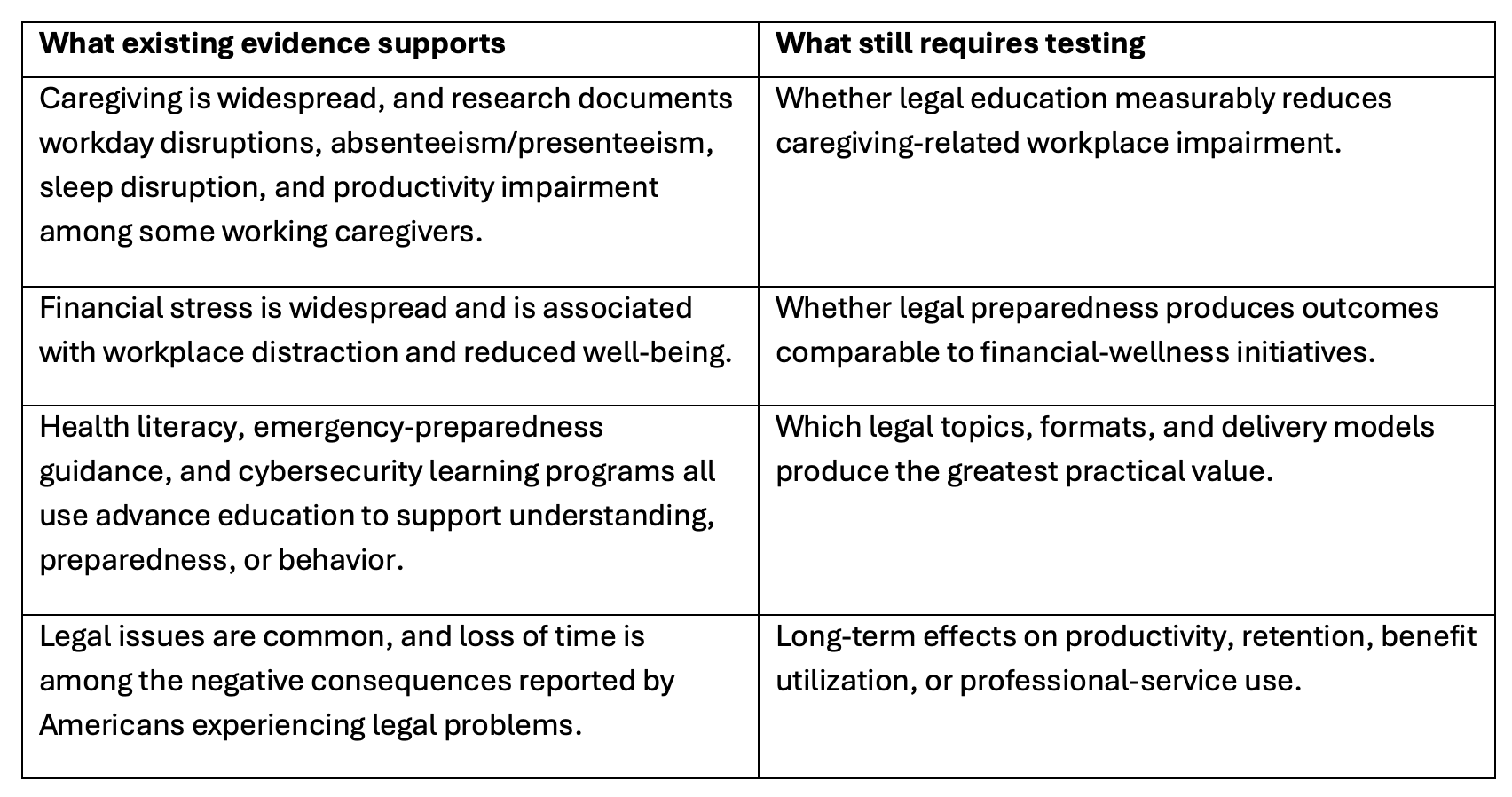
The absence of definitive outcome research is not a reason to make unsupported claims. Nor is it a reason to ignore the question. It is a reason to proceed with intellectual honesty: distinguish evidence from inference, pilot thoughtfully, and measure what happens.
Questions for Organizational Leaders
How often do employees encounter legal questions during caregiving, bereavement, divorce, estate planning, disability, or other major life transitions?
How much time is spent simply determining where to begin or which professional resource is appropriate?
Do current financial wellness, caregiver, EAP, or legal-plan benefits include practical education before a crisis?
Could foundational legal education help employees use existing professional benefits more effectively?
What outcomes would make a pilot worthwhile: participation, confidence, plan completion, appropriate referrals, or reduced uncertainty?
These questions do not presume that every organization needs a broad legal-wellness program. They invite leaders to examine a category of employee preparedness that has received relatively little focused attention despite its frequent intersection with the life events employers already support.
Conclusion
The modern workplace increasingly recognizes that employees do not leave life at the office door. Physical health, mental health, financial strain, caregiving, and grief can all affect work, and organizations have developed a range of preventive and supportive responses.
The legal dimension of life has largely remained outside that evolution—not because it is unimportant, but because it has rarely been framed as a wellness or preparedness issue. Every year, employees confront legal questions while managing illness, caregiving, death, financial uncertainty, and family change. Many begin with little practical understanding of the system they are entering.
The evidence reviewed here does not prove that Preventive Legal Wellness will improve productivity or reduce costs. It supports a narrower and more defensible conclusion: legal preparedness is sufficiently connected to common life events, employee stressors, and established educational models to warrant serious experimentation and study.
Preventive Legal Wellness should be treated as a hypothesis to test, not a conclusion to declare. The relevant next step is to evaluate whether practical, carefully bounded legal education can help people navigate consequential life events with greater confidence - and whether that added preparedness creates measurable value for the organizations that serve them.
About the Author
Brooke Hardie is an attorney with more than twenty-five years of experience in civil litigation, estate planning, and probate law. Her work focuses on translating complex legal concepts into clear, accessible education that helps individuals and families make informed decisions before and during major life events.
Endnotes
Sources and data last verified October 21, 2026. Statistical claims are stated to match the scope and limitations of the cited source.
1. PwC, 'PwC's 2026 Employee Financial Wellness Survey,' April 14, 2026. Reports that 59% of respondents were financially stressed and discusses effects on productivity, engagement, mental health, sleep, and self-esteem. https://www.pwc.com/us/en/services/consulting/human-resources/library/employee-financial-wellness-survey.html
2. AARP and National Alliance for Caregiving, Caregiving in the US 2025, July 24, 2025. Reports 63 million U.S. family caregivers, or nearly one in four adults. https://www.aarp.org/pri/topics/ltss/family-caregiving/caregiving-in-the-us-2025/
3. Ari Houser, Selena Caldera, Brendan Flinn, and Rita Choula, AARP Public Policy Institute, 'The Economic Value of Family Caregiving,' March 26, 2026. Estimates that 59 million caregivers of adults provided 49.5 billion hours of care in 2024, valued at $1.01 trillion. https://www.aarp.org/pri/topics/ltss/family-caregiving/valuing-the-invaluable-2026-update/
4. National Alliance for Caregiving and AARP, 'Working While Caregiving,' Caregiving in the US 2025, July 2025. Reports that 70% of working-age family caregivers are employed, 60% of all family caregivers work while caregiving, and 49% of working caregivers go in late, leave early, or take time off during the day to provide care. https://www.caregivingintheus.org/reports/working-while-caregiving-3/
5. Maningbe B. Keita Fakeye et al., 'Caregiving-Related Work Productivity Loss among Employed Family and Other Unpaid Caregivers of Older Adults,' Value in Health 26, no. 5 (2023): 712-720; published online August 13, 2022. Reports caregiving-related absenteeism/presenteeism and an annualized productivity-loss estimate of approximately $5,600 per employed caregiver in the study population. https://pmc.ncbi.nlm.nih.gov/articles/PMC9922792/
6. Rebecca Robbins et al., 'The Hidden Cost of Caregiving: The Association Between Self-Reported Caregiving-Related Awakenings and Workplace Productivity Impairment,' Journal of Occupational and Environmental Medicine 64, no. 1 (2022): 79-85. https://pmc.ncbi.nlm.nih.gov/articles/PMC8727389/
7. Institute for the Advancement of the American Legal System (IAALS) and The Hague Institute for Innovation of Law (HiiL), Justice Needs and Satisfaction in the United States of America, September 1, 2021. National study of more than 10,000 Americans; IAALS reports that 66% experienced at least one legal issue in the prior four years and lists loss of time among the most common negative consequences. https://iaals.du.edu/projects/us-justice-needs
8. American Psychological Association, 'Grief.' Describes common features of grief including physiological distress, confusion, yearning, and apprehension about the future. https://www.apa.org/topics/grief
9. Jack Purrington et al., 'Psychological Adjustment to Spousal Bereavement in Older Adults: A Systematic Review,' OMEGA - Journal of Death and Dying (first published 2021; issue publication 2023). Reviews post-bereavement changes including sleep, appetite, concentration, anxiety, and depression in older adults after spousal loss. https://pmc.ncbi.nlm.nih.gov/articles/PMC10568953/
10. SHRM, 'Holidays Can Be Hard for Grieving Employees; Employers Can Offer Support,' 2023. Notes that returning to work does not necessarily mean an employee is fully ready to concentrate or be productive. https://www.shrm.org/topics-tools/news/employee-relations/holidays-grief-managers-support
11. Megan Winter and George Reeves, 'Rethinking Bereavement Policies for a Modern Approach to Well-Being,' SHRM, May 16, 2025. Discusses time needed for funeral, estate, and financial matters following a loss. https://www.shrm.org/topics-tools/employment-law-compliance/rethinking-bereavement-policies-modern-approach-to-well
12. PwC, Global Workforce Hopes and Fears Survey 2023. Reports that financially stressed employees were nearly five times as likely to say personal finance issues distracted them at work. https://www.pwc.com/gr/en/publications/specific-to-all-industries-index/hopes-and-fears.html
13. Luona Lin and Juliana Menasce Horowitz, Pew Research Center, 'Experiences with Estate Planning and Discussing End-of-Life Preferences,' November 6, 2025. Survey of 8,750 U.S. adults; 32% reported having a will and 31% a living will or advance health care directive. https://www.pewresearch.org/social-trends/2025/11/06/experiences-with-estate-planning-and-discussing-end-of-life-preferences/
14. Kyoung Tae Kim and Richard Stebbins, FINRA Investor Education Foundation, What We Leave Behind: Financial Education and Estate Planning, May 2021. Using 2018 National Financial Capability Study data, the brief reports associations between financial education and will ownership, including the 42% and 58% likelihood estimates discussed in this paper. https://www.finrafoundation.org/sites/finrafoundation/files/2024-10/What-We-Leave-Behind-Financial-Education-and-Estate-Planning.pdf
15. U.S. Department of Health and Human Services, Office of Disease Prevention and Health Promotion, 'Health Literacy in Healthy People 2030.' https://odphp.health.gov/healthypeople/priority-areas/health-literacy-healthy-people-2030
16. Annamaria Lusardi and Olivia S. Mitchell, 'Financial Literacy and Retirement Planning in the United States,' NBER Working Paper No. 17108, 2011. https://www.nber.org/papers/w17108
17. Annamaria Lusardi and Olivia S. Mitchell, 'Financial Literacy and Planning: Implications for Retirement Wellbeing,' NBER Working Paper No. 17078, 2011. https://www.nber.org/papers/w17078
18. Stanford University, 'Annamaria Lusardi - Stanford Profiles.' Current profile identifies Lusardi as a Senior Fellow at the Stanford Institute for Economic Policy Research, Director of the Financial Freedom Initiative, and Professor of Finance (by courtesy) at Stanford Graduate School of Business. Accessed October 21, 2026. https://profiles.stanford.edu/annamaria-lusardi
19. The Wharton School, University of Pennsylvania, 'Olivia S. Mitchell.' Current profile identifies Mitchell as the International Foundation of Employee Benefit Plans Professor, Professor of Business Economics and Public Policy and Insurance/Risk Management, and Executive Director of the Pension Research Council. Accessed October 21, 2026. https://bepp.wharton.upenn.edu/profile/mitchelo/
20. Federal Emergency Management Agency, Preparedness Toolkit, 'Plan to Deliver Capability.' Describes planning as a methodical process for thinking through the life cycle of a potential crisis, determining capabilities, and establishing roles and responsibilities. Accessed October 21, 2026. https://preptoolkit.fema.gov/web/plan-to-deliver-capability
21. National Institute of Standards and Technology, 'About NIST.' NIST is a non-regulatory federal agency within the U.S. Department of Commerce. Accessed October 21, 2026. https://www.nist.gov/about-nist
22. National Institute of Standards and Technology, NIST SP 800-50 Rev. 1, Building a Cybersecurity and Privacy Learning Program, September 2024. Provides a life-cycle approach to awareness, training, education, behavior change, metrics, and program evaluation. https://csrc.nist.gov/pubs/sp/800/50/r1/final
23. Julie Haney et al., NISTIR 8420A, Approaches and Challenges of Federal Cybersecurity Awareness Programs, March 2022. Documents common federal awareness-program practices, including required training and phishing simulations. https://csrc.nist.gov/pubs/ir/8420/a/final
